

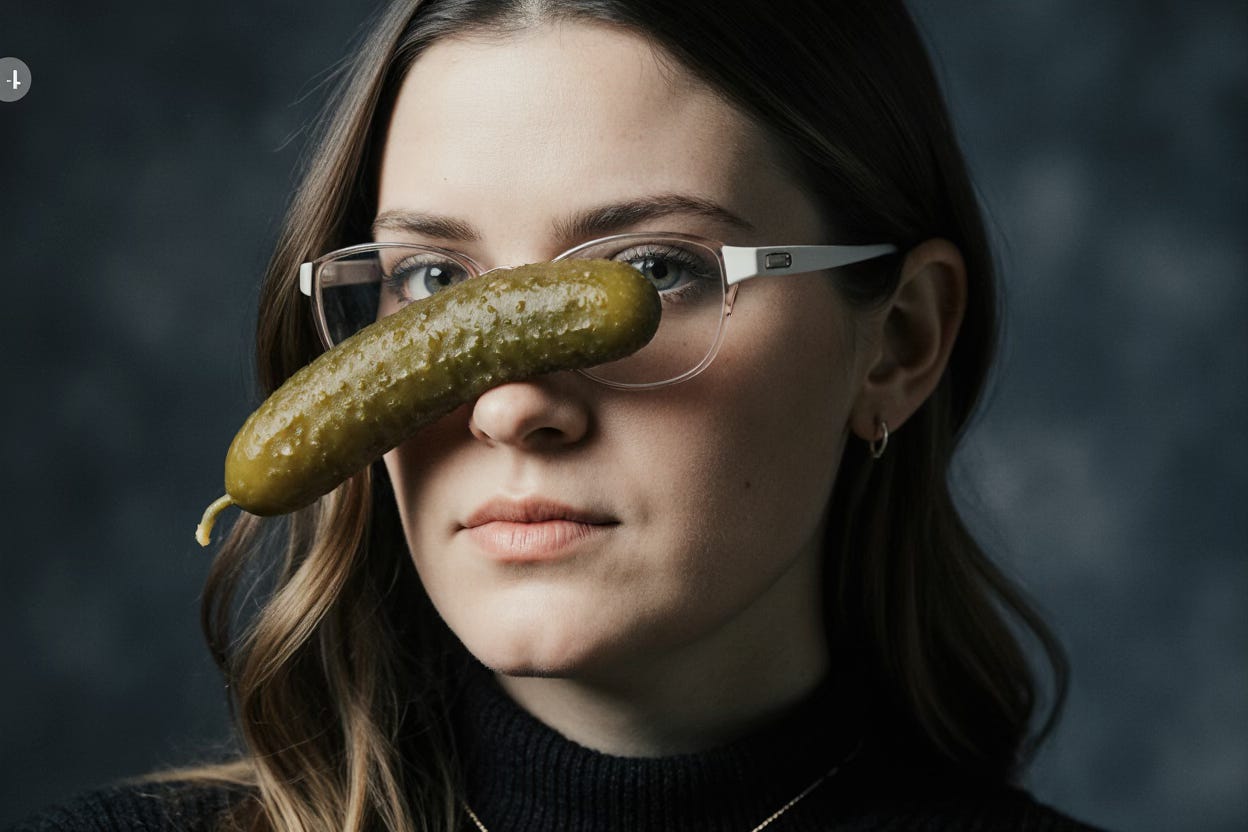
So maybe you saw the announcement today. It arrived with that soft, confident glow that usually signals something meant to feel inevitable. Pickle has entered the chat, and it introduced itself as “the computer for your soul.”
That’s a big idea. Big enough that it’s worth pausing before we decide whether to nod or laugh or quietly keep scrolling. A computer—for your soul. Which immediately raises a gentle, very human question: what does your soul seem to be doing wrong that it now needs an operating system?
Let’s not answer that yet. Let’s warm up with something we already understand.
Most of us already have a decent relationship with tools that help us see. Glasses sharpen blurry edges. Telescopes let us peer across absurd distances. Microscopes reveal worlds hiding in plain sight. And there’s a quiet rule governing all of them: when they’re working properly, you forget they exist. You don’t admire the lens. You don’t negotiate with it. You look through it, and the world gets clearer.
That rule is so reliable that it’s almost boring—until someone breaks it.
Pickle doesn’t just propose a better lens. It proposes putting something else there entirely. Software. Old-fashioned software. UI elements. Text. Semantic overlays. The same symbolic machinery we’ve spent decades carefully confining to rectangles we voluntarily stare at—now pumped directly into the space where trees, faces, sidewalks, and other humans already live.
And this is the moment where I find myself leaning back and asking, not rhetorically but genuinely: why would this be good?
Your visual system is not a spreadsheet waiting for labels. It’s not a chat interface hoping for prompts. It is a fast, messy, beautifully adaptive sense, evolved over hundreds of millions of years, that deals in ambiguity, depth, motion, and implication. It notices without naming. It understands before it explains. It lets meaning emerge instead of insisting on it. It even sees what it wants or needs to see, unlike a camera.
Traditional software UI works precisely because you choose to enter that mode. You open the app. You accept the experiential paradigm and its constraints. You agree, temporarily, to live in a world of buttons and text. Vision doesn’t get that choice. It’s always on. It’s already busy.
So when someone says, “What if we just put the UI there,” they’re not adding information. They’re imposing a semantic layer—an insistence on interpretation—right in the middle of perception doing its own quiet work. Instead of helping you see, the system starts telling you what you’re seeing. And once you notice that, something flips. The world stops being primary. The interface does. Friction ensues.
But never mind that glaring problem. Pickle’s big differentiating idea now arrives.
Pickle’s central move is that it records everything you see, all the time. This is framed as a breakthrough, as though the defining problem of human experience were insufficient storage. Your life, captured continuously, preserved for later consultation. No more gaps. No more forgetting.
At first glance, this sounds almost comforting. Who hasn’t wished they could rewind a moment? But think carefully about what you’d actually want to retrieve.
If I show you a photograph from years ago, the image itself is rarely the point. What hits you is the feeling you had then. The judgment you made. The meaning that flared up in that instant. None of that lives in the pixels. The camera caught the light. Your mind did the important part.
That’s the trouble. The most valuable data in any experience isn’t what entered your eyes. It’s what happened after. The raised eyebrow. The sudden insight. The quiet sense that something mattered. That layer is not recordable. It exists briefly, does its work, and disappears.
And Pickle seems to know this, because after recording everything, the responsibility quietly shifts to you. You’re expected to go back later and curate the archive. Label it. Explain to the system what was important. Help it reconstruct meaning after the fact. There is scant evidence any of us can actually do that, and less that we would want to.
Anyone who has ever promised themselves they’ll organize their photo library someday knows how optimistic that is. Or their inbox. Or their notes app. The archive grows. The intention fades. Meaning does not survive backlog.
So now the shape of the bargain Pickle is offering becomes clearer. First, accept a software interface in your visual field. Then, accept constant recording. Then, accept that you will do the hard work later to make any of it useful. And all the while, you’re asked to adapt—to behave differently as a perceptual, cognitive being in the world—for a payoff that, when you strip it down, amounts to not having to glance at your phone quite as often.
That’s a remarkably small reward for a remarkably large intrusion.
None of this is unprecedented. We’ve seen this confidence before. Google Glass promised frictionless augmentation. Meta Glasses promise seamless capture. Apple Vision Pro and Magic Leap before that promised a spatial future so compelling you’ll happily rearrange your life around it. Different polish, different price tags, same underlying assumption: that being in the world, unannotated, is a problem waiting to be solved, and that using software is what you should be doing instead of whatever you’re actually doing instead.
You might push back here. You might say, “But this is how ambitious products start. You need belief to build something new.” That’s true. But there’s a difference between conviction and curiosity. Conviction builds. Curiosity listens. And when curiosity is missing, the burden always slides onto the user—to adapt, to curate, to tolerate.
So maybe the most useful thing to take away from today’s announcement isn’t an opinion about Pickle at all, but a few easy questions for the next time someone takes a run at this idea.
Does this thing disappear when it’s working, or does it insist on being noticed?
Is it helping perception do what it already does well—or conflicting with it?
Is it capturing what mattered to you, or just what was easy to record?
Who is adapting here: the technology to the human, or the human to the technology?
And finally,
If you take it off, do you miss it, or do you feel like you’ve gotten your eyes back?
You don’t need a computer for your soul to see what’s going on here. You just need to notice where the effort is being spent. When a tool asks you to change how you see, how you remember, and how you behave—just so it can justify being there—it’s not the future arriving. It’s an old idea knocking at the door again, dressed up in a trench coat, hoping you won’t recognize it this time.
Copyright © 2026 by Paul Henry Smith


