

One of the odd pleasures of the past few years has been watching the guardians of culture discover, with theatrical horror, that culture can now be made by people who were not invited to the meeting.
The panic has many costumes. Sometimes it appears in legal robes. Sometimes it arrives as concern for artists. Sometimes it speaks in the language of safety, transparency, authenticity, or ethics. But beneath these costumes is the older and more reliable animal: institutional self-interest, startled out of its nap.
When generative AI first entered public life, the owners of large catalogs of intellectual property faced a genuine problem. Here was a new class of tools that could write, draw, compose, narrate, edit, imitate, remix, summarize, and accelerate creative work with unnerving speed. It did not make everyone a genius, despite the claims of its more excitable salesmen. It did something more disruptive. It made competence cheaper, experimentation faster, and certain old tollbooths easier to avoid.
No established industry smiles at that sort of thing. A publisher prefers publishing to remain difficult. A record label prefers music production to remain difficult. A studio prefers filmmaking to remain difficult. A guild prefers expertise to remain scarce enough to be policed. This is not a conspiracy. It does not require a secret room, a tray of pastries, and a man from legal whispering into a speakerphone. Institutions with similar interests tend to reach similar conclusions, especially when the alternative is watching their leverage leak away.
The first useful conclusion was that AI needed a stain.
The word chosen was theft.
It was an excellent word for the purpose. Theft does not invite curiosity. It ends conversation. Once a thing has been successfully called theft, the public is spared the tiresome burden of asking what was taken, from whom, under what law, with what injury, and by what analogy. The word carries its own gavel.
Whether AI training is legally theft remains unsettled. The courts have not issued the sweeping moral verdict that the rhetoric often implies. The law is still busy doing what law does: moving slowly through distinctions that slogans trample flat. But the cultural verdict did not wait for the legal one. Culture rarely waits for evidence when a satisfying accusation is available.
And so the idea spread. AI training was theft. AI tools were built on theft. AI art was theft-adjacent. AI writing carried the fumes of theft. Even when a particular output copied nothing and infringed no identifiable work, it could still be treated as contaminated by ancestry. The sin had moved upstream. It was no longer necessary to show that the thing produced was unlawful. It was enough to suggest that the machine had once looked upon forbidden material, and that every later creation bore the family curse.
That was the first achievement: not a ruling, but a mood.
The second achievement was more subtle. It divided creators.
Before AI, at least in theory, a work had to stand in the open and take its beating like everything else. A song could be good or bad. A painting could be alive or dead. A novel could reveal the world or merely rearrange furniture in the usual dreary rooms. The creator might be overrated, underpaid, fashionable, derivative, inspired, fraudulent, or dull, but the work itself remained the main exhibit.
AI changed the location of the trial. The artifact stepped aside and the process took the witness stand.
A person could make something original, useful, funny, beautiful, or strange. It could copy no protected work. It could delight an audience. Then, if AI involvement were discovered, the discussion would curdle. The question would no longer be, “Is it good?” It would become, “But how was it made?” And behind that question lurked another one, less polite and more consequential: “Does this person count?”
This is the part worth pausing over, because it is the hinge of the whole affair. The deepest argument about AI is not really about originality. It is about legitimacy.
Who gets to be called a creator? Who is merely a user? Who is experimenting, and who is cheating? Who is assisted, and who is disqualified? The modern world runs on tools so deeply embedded that they have become invisible, yet AI alone has been singled out as the tool that stains the hand. Nobody demands a moral warning label on autofocus. Nobody says a song loses its soul because the producer used pitch correction, digital editing, sample libraries, or software instruments. Nobody asks whether a novelist’s word processor has corrupted the sanctity of prose. But AI, because it arrived suddenly and threatened existing hierarchies, has been assigned a special metaphysical odor.
Then came the next word: slop.
This one was even better than theft because it required no argument at all. Slop is not a legal claim. It is a sneer in a paper hat. It allows the speaker to dismiss the work, the tool, the maker, and the audience in one economical motion.
The joke, of course, is that human beings were producing slop long before a transformer model ever completed a sentence. The world was not a cathedral of taste in 2021. The internet was already full of bad essays, dead-eyed stock photography, cynical pop songs, fake sincerity, recycled jokes, vacant lifestyle content, and videos assembled for the apparent purpose of making time feel insulted. If slop is the crime, humanity has been caught standing over the body with a ladle in its hand.
But the new rhetoric performed a tidy little trick. Bad human work remained merely bad work. Bad AI-assisted work became evidence against AI itself. And if AI-assisted work turned out to be impressive, the charge changed shape. Then it was soulless, uncanny, too smooth, too competent, too suspiciously free of the noble bruises by which we prefer to recognize human effort.
This made acquittal nearly impossible. If the work was poor, AI had debased creation. If the work was good, AI had counterfeited creation. The user could not win, because the point was not to judge the work. The point was to keep the user in a lower caste.
Now we have entered the administrative phase, which is where modern moral campaigns go once the shouting has been converted into policy. The words are disclosure, labeling, watermarking, detection, transparency, authenticity, and trust. These are fine words, buffed to a civic shine. No one wants to be against transparency. It sounds like sunlight, clean glass, and responsible adults in conference rooms.
But labels do more than inform. They sort.
A label creates a class of things. A class of things can be ranked differently, recommended differently, demonetized differently, searched differently, suppressed differently, appealed differently, and explained to advertisers differently. Once AI involvement becomes a detectable condition, the platform gains a new switch. It can say, “This may be allowed, but not promoted.” Or, “This may be visible, but not monetized.” Or, “This may remain online, but only after wearing the little yellow badge of synthetic suspicion.”
Here the interests of large rights holders and large platforms do not need to merge into conspiracy. They merely need to overlap. Music labels already have arrangements with platforms. Their catalogs are licensed, surfaced, tracked, monetized, and made available as raw material for users’ videos. YouTube did not become one of the largest music services in the world by ignoring rights holders. It became one by building machinery that could accommodate them, pay them, identify their works, and keep enough peace for the whole bazaar to remain open.
Once such machinery exists, it can be adapted. The platform has every incentive to classify, filter, and manage risk. The rights holder has every incentive to preserve the status of its own catalog and make life harder for unlicensed competitors, outsiders, and amateurs with suspiciously capable tools. Neither side needs to twirl a mustache. Each simply pulls the levers it already controls.
The trouble is that the levers are attached to a machine that is aging quickly.
AI is not remaining a separate toy called “AI.” It is sinking into the floorboards of production. It is becoming an option in the editor, the camera, the audio workstation, the design app, the writing tool, the translation layer, the color corrector, the compression system, the search box, the thumbnail generator, the captioning tool, the recommendation engine, and the feature nobody notices until it stops working. It will not always announce itself with a glowing button and a wizard icon. It will be buried in the workflow, doing small useful things by the thousand.
A musician may use AI to sketch a bass line and then record it with a human player. A filmmaker may use AI to find the strongest sixty seconds in an hour of footage. A podcaster may use AI to clean background noise, generate a transcript, translate the episode, suggest clips, and produce show notes. A designer may use AI to extend an image, test layouts, name layers, and create variants. A teenager may make a video that is “AI-assisted” in six different ways without ever thinking of it as an AI project.
What, exactly, is the label supposed to label?
At first, the distinction seems obvious. Some content is AI-generated, and some is not. Then the tools improve. Then the features spread. Then the category begins to blur at the edges. Then it blurs everywhere. The question stops being whether AI was used and becomes whether its use was meaningful, material, deceptive, incidental, aesthetic, administrative, invisible, or simply part of ordinary software. At that point, the old binary starts to look less like a principle and more like a temporary filing system maintained by anxious clerks.
There is another problem. Audiences are not always as pure in their preferences as moral campaigns require them to be. People often like what they like before they know how it was made. Tell them afterward that AI was involved, and you may create not enlightenment but dissonance. They enjoyed the song, laughed at the video, used the image, learned from the explanation, or shared the clip. Then the label arrives, wearing its little official shoes, and informs them that their pleasure may require adjustment.
That may work for a while. Shame is a powerful user-interface pattern. But it is a dangerous business to train audiences to distrust things they plainly enjoy, especially when the distrusted method is becoming ordinary across the rest of their lives. The public can be moralized into confusion, but not forever. Eventually convenience, usefulness, and pleasure begin eating the sermon from underneath.
Meanwhile, the institutions issuing the sermon will use the tools themselves. Of course they will. They would be deranged not to.
The record label that warns against AI will use AI to analyze hits, generate concepts, test markets, clean audio, explore hooks, and speed production. The studio that worries aloud about authenticity will use AI in development, editing, localization, effects, marketing, and audience analysis. The publisher that laments machine writing will use machine writing to draft catalog copy, summarize manuscripts, translate samples, and prepare campaigns. The platform that labels AI for the public will depend on AI internally for nearly everything it does at scale.
This is not hypocrisy in the dramatic sense. It is the normal metabolism of power. A tool is dangerous when it strengthens outsiders and prudent when it strengthens incumbents. The moral vocabulary changes according to who is holding the instrument.
The great comic element is that the campaign may be defeated not by argument, and not even by law, but by adoption. The more creators use AI, the harder it becomes to maintain a useful stigma around AI creators. At the beginning, a boundary can be drawn with a ruler. On one side are the approved makers, on the other the suspicious ones. But then the suspicious ones multiply. They include students, illustrators, editors, teachers, musicians, small businesses, podcasters, filmmakers, animators, marketers, game designers, and eventually the very companies that helped popularize the suspicion. The border does not get crossed in one dramatic march. It is crossed casually, daily, almost absentmindedly, until one morning everyone looks up and realizes the checkpoint is standing in an empty field.
This is how technological panics usually decay. Not with a confession. Not with a clean victory. Not with the old guard saying, “We were wrong, and the future may proceed.” They decay because the disputed tool becomes too common to isolate. Photography did not remain a scandal once everyone had a camera. Digital editing did not remain an outrage once every studio depended on it. The synthesizer did not destroy music; it entered music, changed it, and then became part of the furniture. The internet was once treated as an alien force corrupting publishing, journalism, commerce, childhood, politics, and attention. Some of that was even true. Yet the internet did not remain a separate moral category. It became the weather.
AI is headed toward the same condition. Not because every claim made for it is true. Not because every criticism is foolish. Much AI work is bad. Some uses are exploitative. Some disclosures are reasonable. Some legal questions are serious. But none of that rescues the larger distinction from its fate. A society cannot permanently divide creators into clean and unclean based on a tool that is becoming part of nearly every act of digital creation.
The lasting question will not be whether AI was involved. It will be what the human being was trying to do with it. That is a less convenient question for gatekeepers because it returns attention to judgment, intent, skill, taste, and result. It asks whether the work matters, not whether the workflow can be ritually purified. It treats tools as tools and creators as responsible for what they make with them.
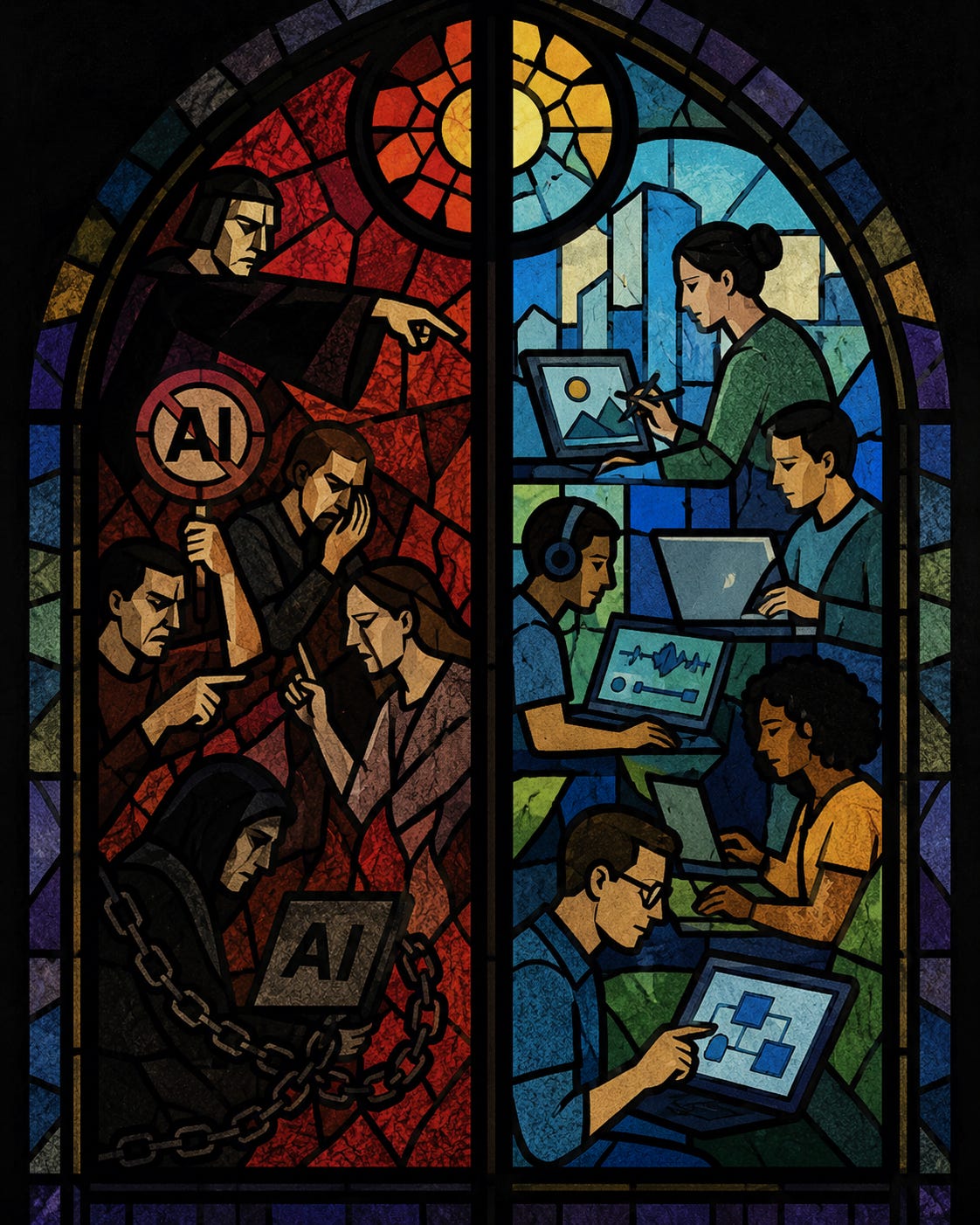
That is where the argument is going, whether the current priesthood likes it or not. For a brief historical moment, it has been possible to make AI use feel like a confession. Soon it will feel like admitting that one used software. The accusation will not disappear because it was answered point by point. It will fade because it no longer points to a distinct class of people. The heretics will not storm the cathedral. They will become the congregation, the choir, the janitorial staff, and eventually the committee in charge of refurbishing the stained glass.
Then the label will lose its magic. The stain will not wash away. It will simply become too widely distributed to function as a stain. And the thing now treated as a threat to creation will take its place among the ordinary instruments of creation, where yesterday’s miracles always end up: not on the altar, not in the dock, but in the drawer with the scissors, the tape, the charger, and the spare batteries.
Copyright © 2026 by Paul Henry Smith


